Formed in clay.
The material begins as clay. Hand forming introduces small differences that remain visible in the finished surface.
A closer look at Moroccan zellige: its depth of glaze, its hand-cut character, and the decisions that turn a design into a lasting surface.
Depth in the glaze. A finely cut edge. A rhythm made piece by piece. Let the material lead your next decision.
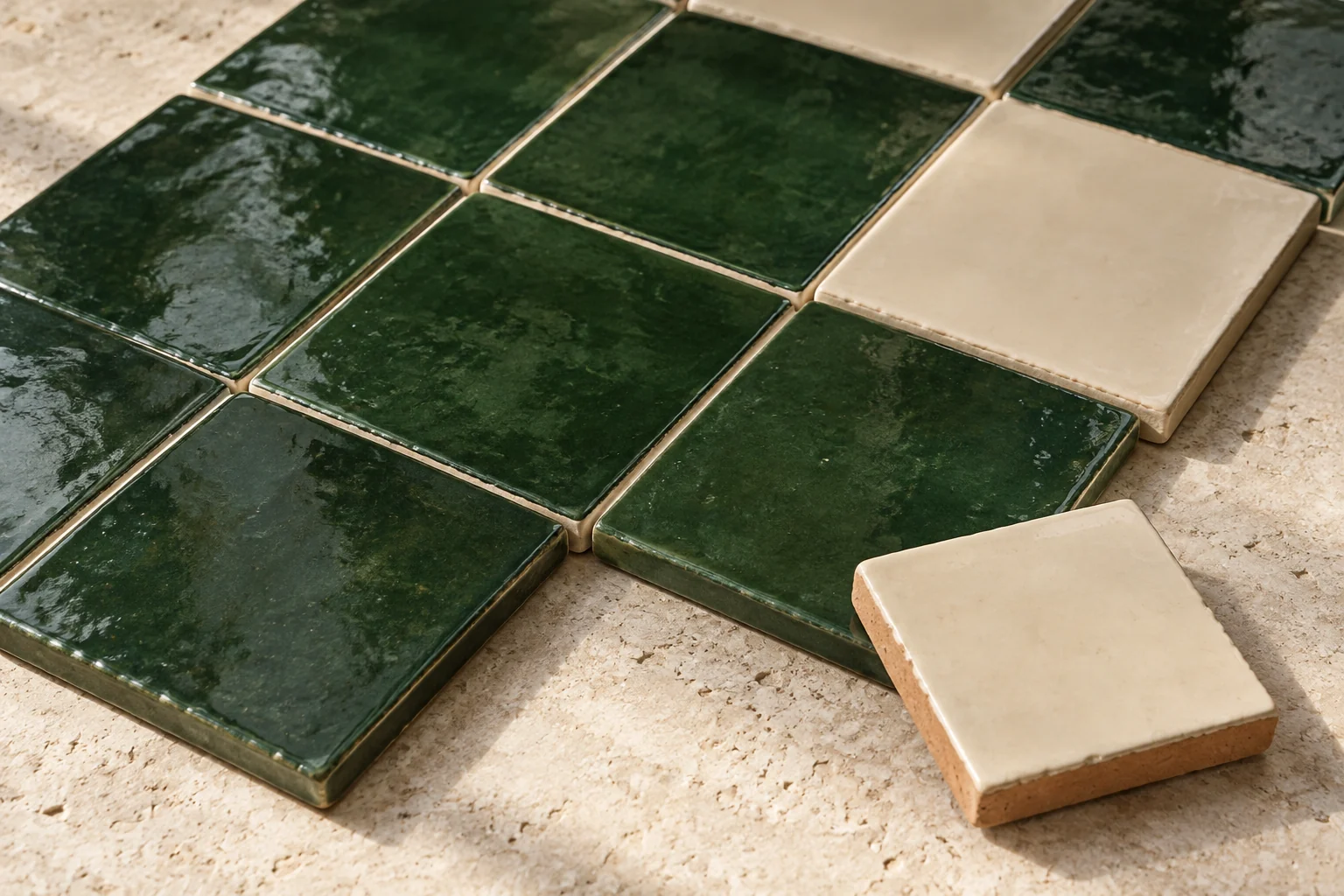 Explore Forest
Forest and ivory, considered up close. Explore these tones beside the stone, wood and fabrics in your room.
Physical samples confirm color and finish. Explore stars & crosses
Cobalt, ivory and ochre. Individual shapes create a continuous field, finished with a considered edge.
Physical samples confirm color and finish.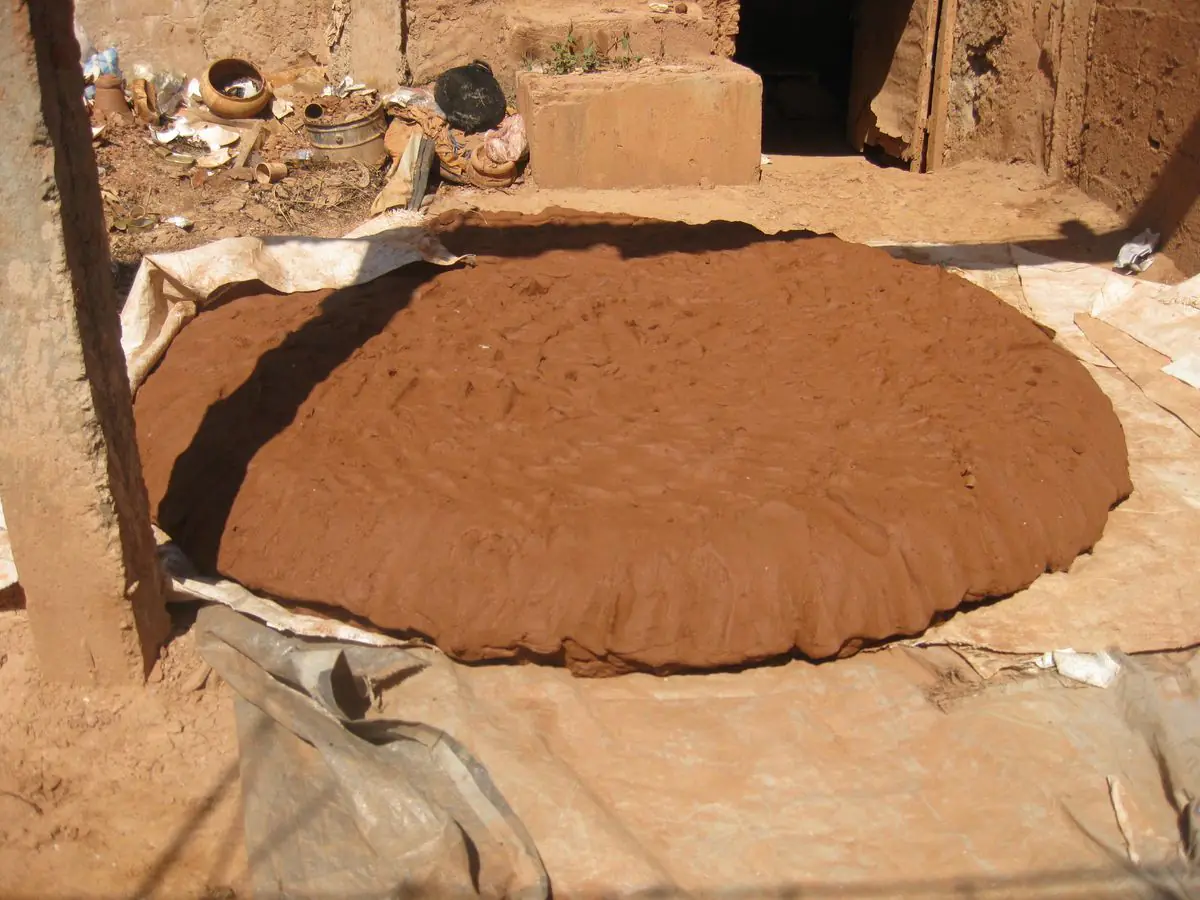
Zellige begins with clay. It is soaked, worked by foot and by hand, formed into square tiles and dried in the sun before a first firing.
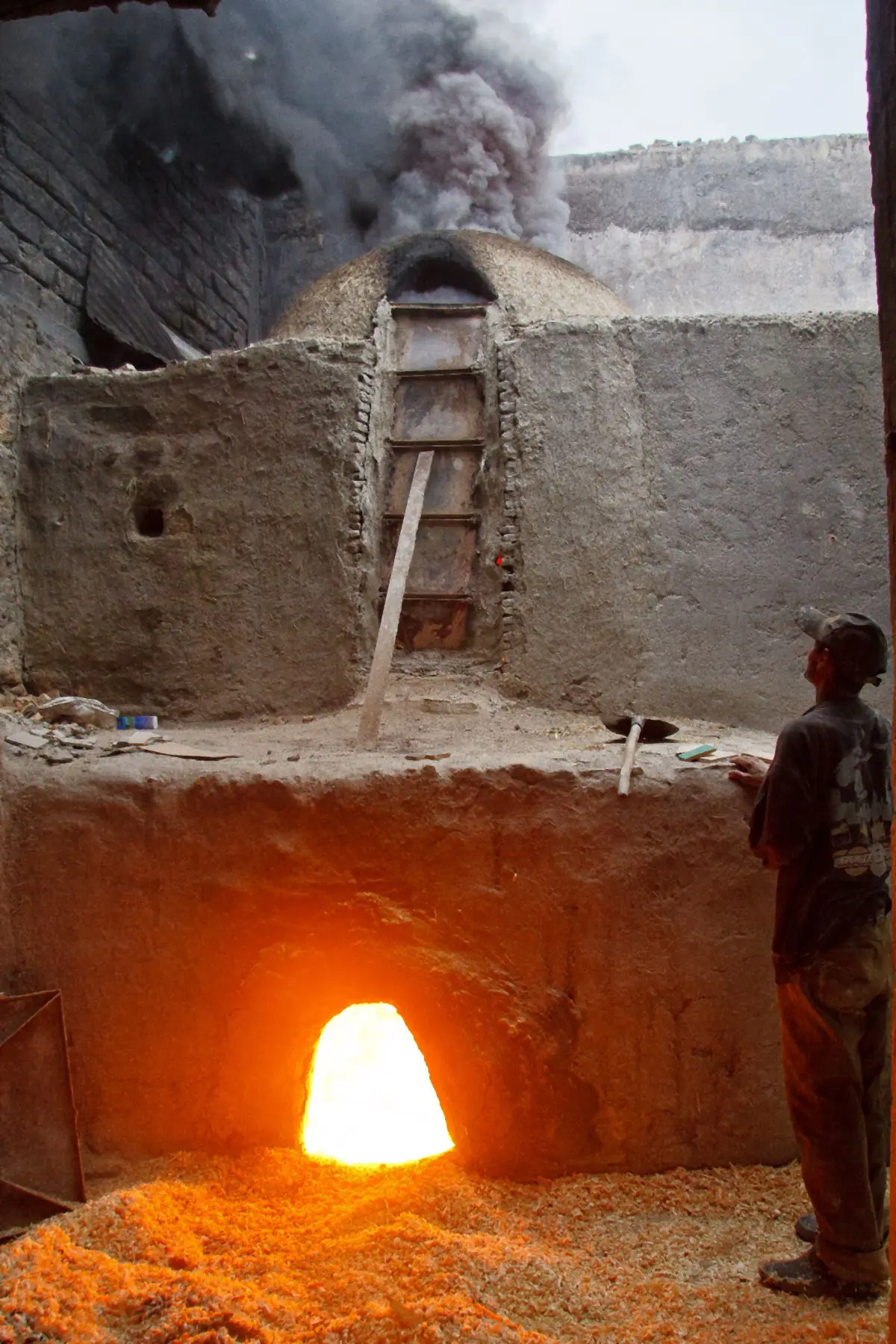
Each fired tile is glazed on one face in a single color and fired again in a kiln. Small differences in glaze thickness and heat give every piece its own depth of color.
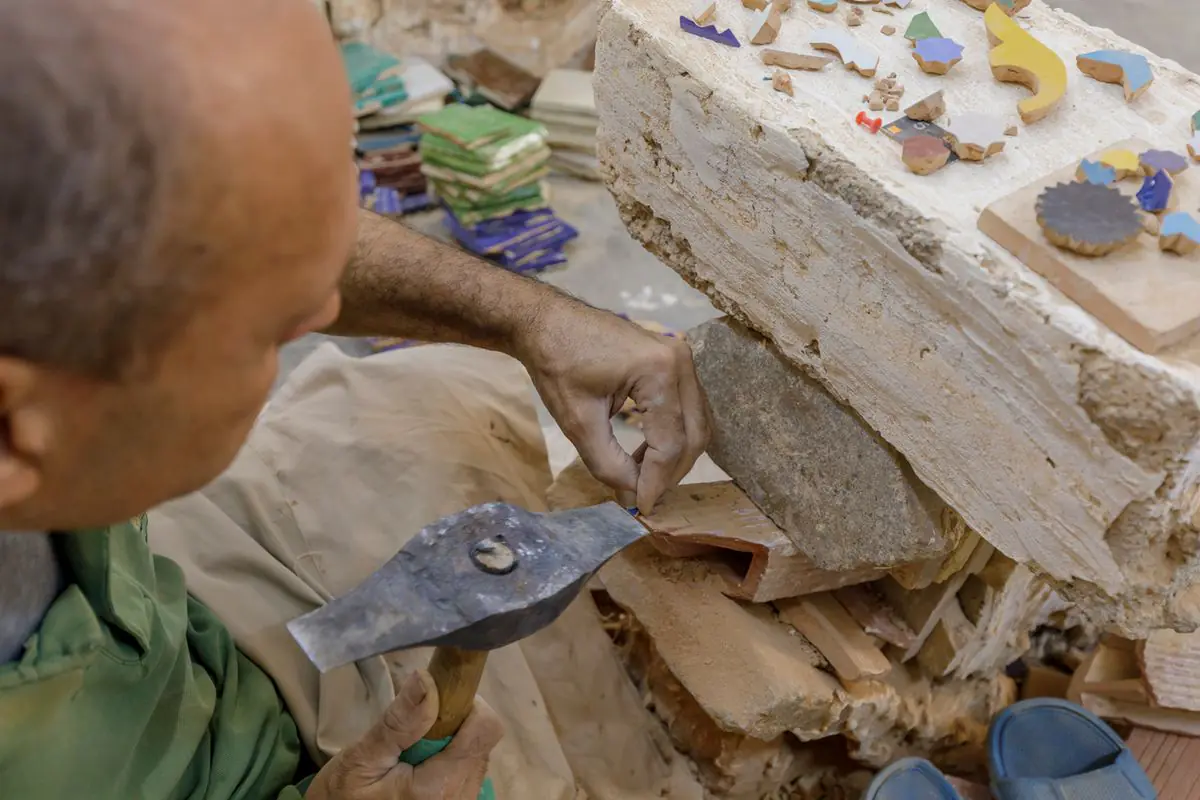
Seated craftsmen cut the glazed tiles into small shapes with a sharp hammer called a menqach, following a pattern and bevelling each edge so the pieces fit closely.
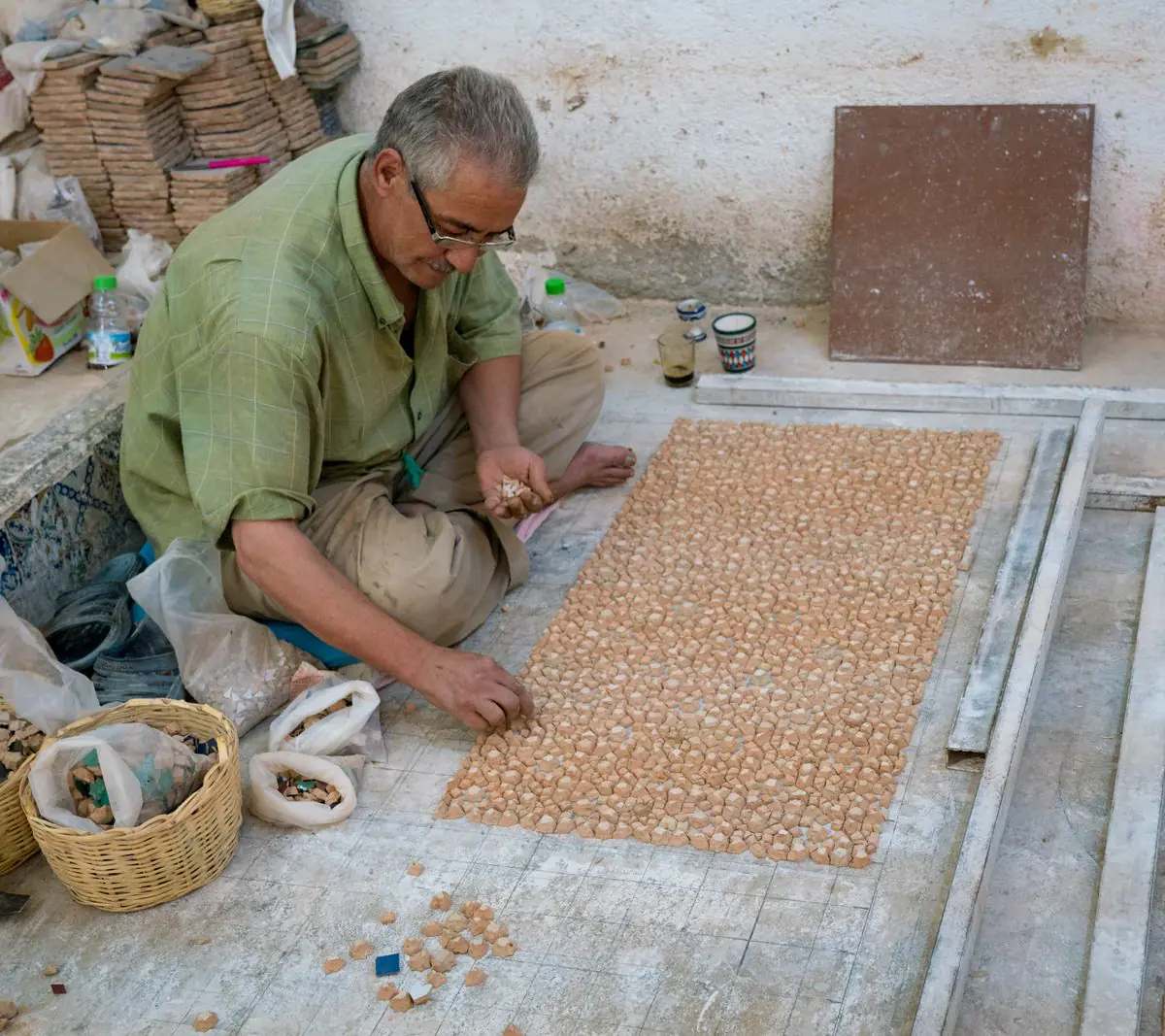
The pieces are laid face down in the pattern, so the maker works from their unglazed backs. Plaster is poured over them, and the finished panel is lifted and set into the wall.
Our Moroccan zellige collection is manufactured in Fès, Morocco. These credited photographs document the wider craft tradition, rather than our own workshop.

Zellige is a Moroccan tradition of glazed clay tile. Its appeal comes from small differences: a slightly rippled face, an irregular edge, a deeper pool of color. Together, those details give a wall its movement.
The study alongside uses our editable octagon field, in Forest and Chalk. It lets you explore color, geometry and light; physical samples will show the actual glaze and variation in your room.
Explore the glaze libraryThe material begins as clay. Hand forming introduces small differences that remain visible in the finished surface.
Glazing and firing create the depth and tonal variation that make a field of one color feel alive.
Edges and shapes become part of the composition. The pattern is precise; its surface has a human quality.
Daylight and evening light bring out different tones. Consider your palette alongside your room’s other materials.
From Fez to the Alhambra, cut tile brings color and geometry into architecture. These books and museum records offer a closer view of that shared Moroccan and Andalusian tradition.
Traditional Islamic Craft in Moroccan Architecture, volumes I and II. Atelier 74, 1980. A reference listed in Harvard Library’s guide to Islamic art and architecture.
Harvard Library recordThe Art of Moroccan Ceramics, John Hedgecoe and Salma Samar Damluji. Garnet, 1992. Find the book through the Bibliothèque nationale de France catalogue.
View the book recordIslamic Geometric Patterns, revised edition, 2019. The publisher’s selection includes examples from Chellah in Rabat and the Zaouia Moulay Idriss II in Fez.
Explore the publisher’s guideA crenellation-like upper frieze. The Batha Museum’s record of an inscribed band from Buinaniya in Fez places Charafa above that band, between ceramic and plaster decoration. Our Charafa is an original interpretation of this top-edge role.
Read the museum recordOur studio patterns are original design studies. The book links are references for further reading; complete volumes have not been reviewed or reproduced here.
A palace panel, a regional archive, a living workshop: each offers a different way to understand zellige. Explore the references behind our continuing design studies.
MIT Libraries’ Tiling Search connects geometric patterns with places and published references. Its regional indexes make it possible to explore related designs across Morocco and Spain.
Explore Morocco Explore SpainTiling Search traces F13 to the Royal Palace in Marrakesh, citing Paccard, volume I, pages 420–421. Its intricate star-and-interlace composition is a reference for exploration, rather than a reproduction offered in our studio.
View the F13 recordThe creator of Tiling Search explains how photographs, color and location inform its geometric drawings. An archive drawing can clarify a pattern’s structure; its colors need not be an exact record of the original surface.
Read Wichmann’s introductionAlmira’s workshop collections bring together traditional compositions, simple shapes and finishing bands. Their catalogue is a contemporary craft reference, with its own designs and specifications.
Explore Almira’s collections View Classics View BordersThese are independent references, not affiliations. Tiling Search identifies its content under CC BY-NC-SA 2.0; Almira’s reuse terms require written consent. Their images and drawings are not reproduced here. We have not reviewed the complete Paccard volumes.
A beautiful panel has more than a recognizable star. Museum records show how cut pieces, connecting lines and architectural edges work together. These four ideas offer a way to look more closely.
A fourteenth-century panel from Buinaniya combines a white knotwork network with colored pieces fitted into its openings. The surrounding shapes are part of the design, as carefully considered as the main motif.
Study the Batha panelA surviving Badi Palace panel organizes its geometry around a sixteen-point star. A centered composition has a different rhythm from an endlessly repeating field; give its focal point room to read.
Explore the radial panelInterlace depends on the path through a composition. Tiling Search notes that Paccard’s volume I, page 197, has three strands in the original interlacing—a detail that a simplified diagram can lose.
Read the interlace referenceThe Buinaniya record describes ceramic panelling, an inscribed band, Charafa and plaster above. Consider where a surface begins and ends; a finishing frieze has an architectural role of its own.
See the documented sequenceA motif can appear in several materials. Tiling Search cites Paccard volume II for inlaid cedar at Ifrane, page 408, and a Rabat ceiling panel, page 417(/6). These are source references, not tile specifications. For further study, explore Castéra’s Arabesques and Bonner’s construction-method overview. We reviewed accessible records and publisher descriptions, not the complete books.
Explore studies, guide & archiveConfirm the tile’s suitability for your chosen surface with your supplier. Wet areas, floors, outdoor walls and surfaces near heat have different requirements.
Ask an experienced installer to confirm the substrate, waterproofing, adhesive, grout and cutting allowance. Our studio provides a design and planning brief; the final installation specification belongs with your supplier and installer.
Screen settings, lighting and natural glaze variation change how color appears. Use the digital studio to narrow your direction, then examine physical samples beside your actual cabinetry, stone, paint and textiles.
Yes. Open the AI designer and upload up to three images, add up to four public links, and describe what you love. It proposes three editable design directions. Choose which sampled colors guide the palette, then refine a direction with AI. Lock the geometry, field palette or full border while changing other details. Your last eight consultations remain available to restore.
Yes. Explore the catalog room settings or upload your own photograph through Walls & floors. Choose the surface, fit its outline and enter real measurements to scale the selected 2.5, 5 or 10 cm format. Floors use four-corner perspective with measured width and depth. The advanced room studio also offers saved viewpoints, fixture masks and an optional AI placement suggestion that sends a reduced photo for review. These are design previews; your installer confirms site dimensions and suitability.
The project calculator adds a 10% cutting allowance to your measured area. Complex cuts, pattern matching and installation conditions can require more. Confirm your final quantity with your installer before ordering.
Follow the guidance supplied with the exact tile, grout and any sealer you choose. Confirm suitable cleaning products with your supplier and test them discreetly before wider use. The finish and installation determine the care routine.
Our Moroccan zellige collection is manufactured in Fès, Morocco. Choose your tiles, save a selection and request physical glaze samples through the Samples page. Bespoke work continues through a design consultation. The current checkout is a private Shopify test: no real payment is taken and nothing is dispatched. Final production details and delivery are confirmed before a real order.
Editing starts on your device. In your Portfolio, sign in and choose Save privately to cloud to keep a complete project across devices, including saved inspiration and room images. A review link shares the last cloud-saved snapshot with anyone holding the link; commission contact details are excluded. Withdraw a link at any time. AI design requests send the selected inspiration to OpenAI. The optional AI wall-fit request sends a reduced room photo; ordinary camera placement remains local.
The material study is rendered from our editable catalog, rather than a photograph of supplied tiles. Material guidance is general; confirm the specification of the physical tiles you purchase.